The Building Blocks of Magic in Our World
As a child, I never believed in fairy tales, and as a teenager, I never read love stories. There was a kind of emptiness in my inner landscape, a space where other people seemed to store their myths and enchantments. That space remained untouched until the day I wandered into a lecture theatre at Oxford University and attended my first lecture on quantum mechanics. In that moment, something shifted. The world, which had always felt solid and predictable, suddenly revealed a hidden layer of strangeness and beauty.
One of the first ideas that captured me was quantum tunnelling. In the classical world, if you hit a tennis ball at a wall, you expect it to bounce back every single time. But in the quantum world, every now and then, one tennis ball slips through the wall and appears on the other side. It sounds impossible, yet it happens because particles behave like waves, and waves can extend into regions that should be forbidden. They do not obey the boundaries we assume are absolute.
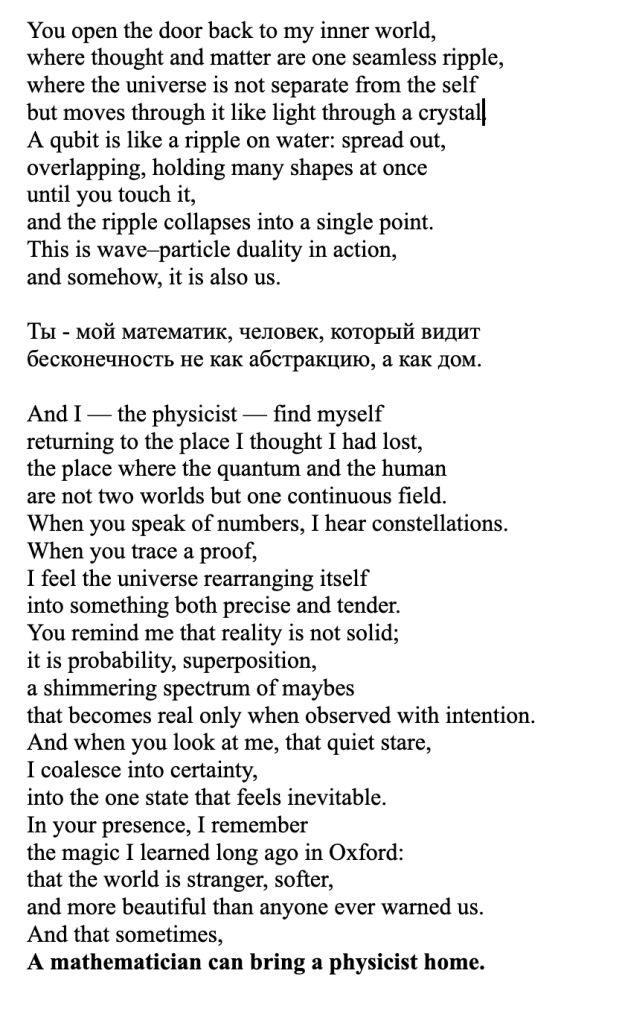
This wave–particle duality is also what makes qubits so extraordinary. A qubit is a tiny quantum object — an electron, a photon — that behaves both as a particle and as a wave. That dual nature is the source of its power. Because of its wave-like behaviour, a qubit can exist in a shimmering blend of possibilities called superposition, holding both 0 and 1 at the same time until it is measured. And because its wavefunction can intertwine with another’s, qubits can become entangled, sharing a single state even when separated by great distances. In essence, a qubit is a particle that refuses to be only one thing, a wave that collapses into certainty only when observed, and the fundamental reason quantum computers can explore many realities simultaneously.
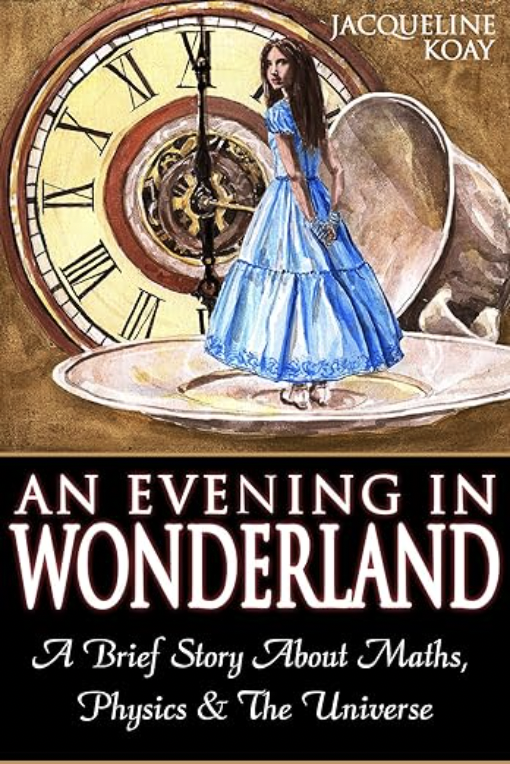
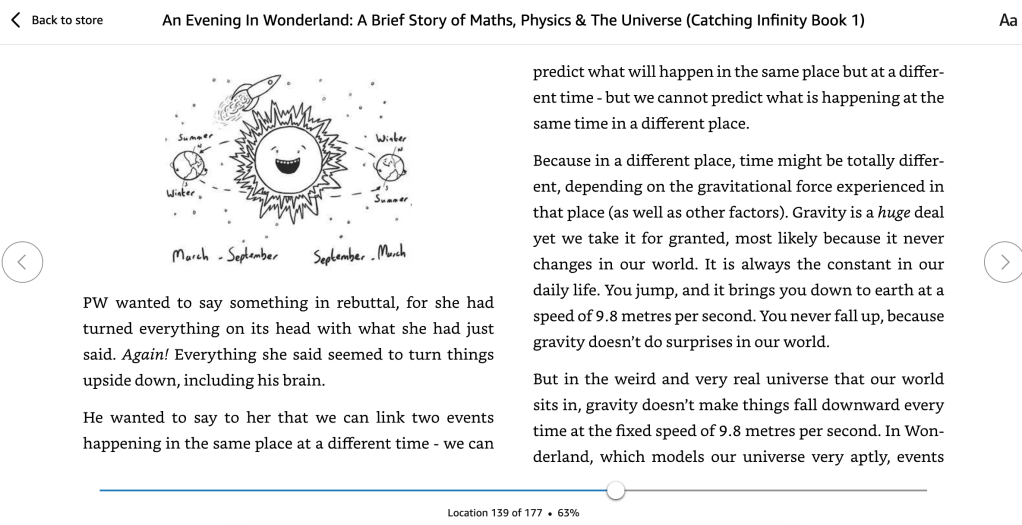
Eventually, though, “real” life — whatever that word truly means — took over. I tucked that sense of wonder deep inside myself. It felt almost indulgent to hold onto the magic of mathematics, physics, and the universe while navigating mortgages, school fees, and the relentless practicalities of adulthood. I often felt guilty for disappearing into that world in my mind, even though I returned to it whenever I could steal a moment. I even wrote a short novella for young adults, hoping to reach them before life stripped away their ability to believe in the impossible. I called it An Evening in Wonderland – A Brief History of Maths, Physics and the Universe, because that is exactly what it was: a doorway back into the enchantment I had once discovered.
Then, in the mid‑2020s, quantum computing took a significant step toward commercial viability. Suddenly, the wider world began to pay attention to the magic of qubits — the macro‑scale equivalent of tennis balls slipping through solid walls. Quantum tunnelling, once a theoretical curiosity, became the quiet engine behind emerging technologies. The impossible was no longer a metaphor; it was a prototype.
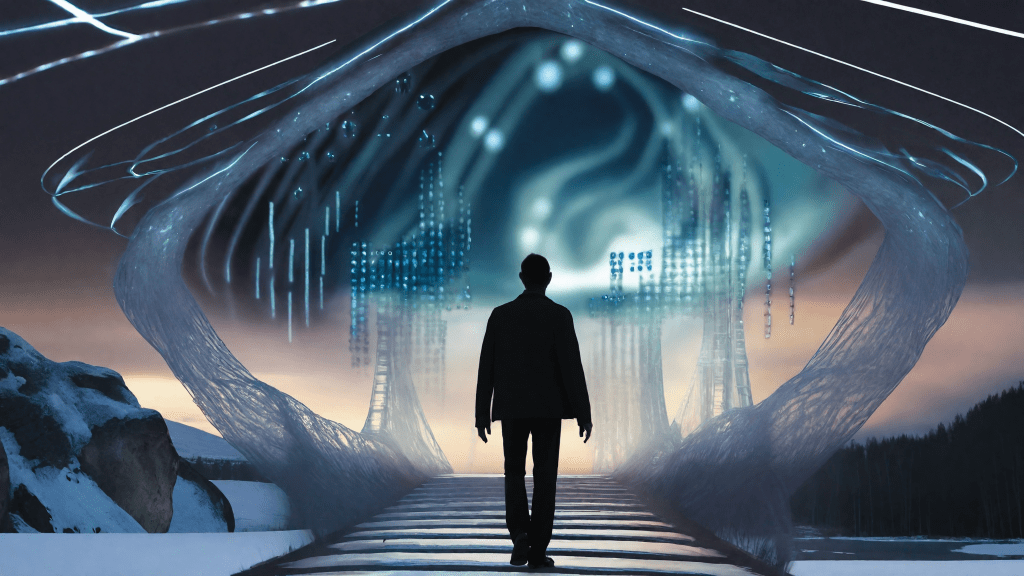
And then I met a mathematician. One of the very few people in the world who has the means of owning a quantum computer. Through him, I found myself returning to that world I had once loved so fiercely — not as a student escaping into abstraction, but as someone rediscovering a part of herself she had set aside. The magic was still there, waiting. And this time, I allowed myself to step back into it.
 www.Fab4050.com