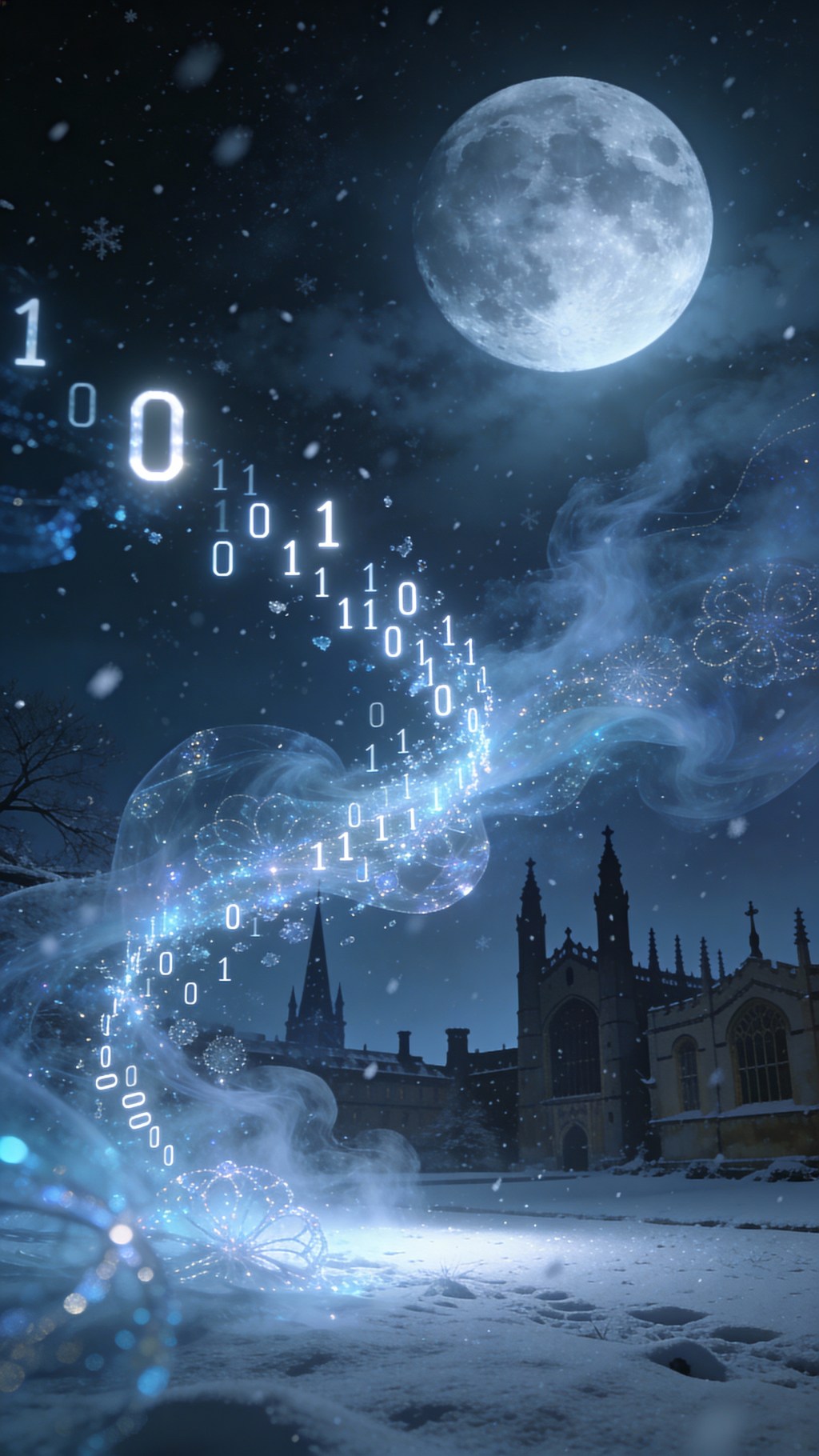
Magic Inside Your Head
The Mathematician and I often find ourselves wandering into debates that begin with tech/maths and end somewhere else totally different. Yesterday, in a late night cafe called Hazev, our dialogue turned to the question of where best to build data centres. He, ever pragmatic, favoured the Nordic countries: their cold climate, abundant renewable energy and efficiency in cooling costs. To him, the Nordics are the rational choice, the place where global traffic flows most smoothly.
I, however, am loyal to my alma mater. I declared that Culham Campus in Oxfordshire is the better option. Culham is already home to the UK Atomic Energy Authority, a site of great strategic importance for advanced computing and AI infrastructure. And just down the road lies Oxford, the best university in the world (of course I would say that, lol, as I am part of Oxford University Innovation). For me, Oxford is not merely a location; it is a sanctuary of thought, a place where ideas are nurtured and where love of knowledge feels inseparable from love itself.
He teased me gently: “I don’t have the luxury to always think Oxford. I have to think about cooling costs, energy and where the traffic will be.” His words carried the weight of practicality, yet I am unwilling to lose even the simplest of arguments.
So I drew a distinction. “Let’s separate data centres from quantum computing,” I said. “You don’t need giant server farms for quantum computing. The real challenge is not size but stability.” In that moment, our debate transformed into something more intimate. Quantum computing became a metaphor for life itself: delicate, patient and requiring balance rather than scale and grandeur.
As often happens, our conversation meandered into space – not the physical cosmos but the human spaces we inhabit. I told him of the windows I sometimes peer into, small humble homes in socially deprived areas. Families gathered beneath a single bulb, sharing dinner together. In those modest rooms, I see warmth, connection and joy. I confessed that I would rather be there than in a vast mansion where unhappiness resides.
“Hilbert Space,” he said simply.
I had to dig deep into my rusty mathematics to see the relationship between Hilbert Space and quantum computing.
Imagine life is a stage (as Shakespeare said, I think). Using this analogy, in classical computing, the stage is small and the actors (bits) can only play two roles, either 0 or 1.
In quantum computing, the stage is a Hilbert Space: it is huge, wide, multidimensional and crucially, flexible. Here, actors (qubits) can perform in superposition, playing 0 and 1 at the same time or entangle with other actors so their roles are linked. Without Hilbert Space, there would be no stage for these performances. It’s so magical, like watching all your favourite fairytales from your childhood coming alive at once, with the characters morphing in and out of roles like well, magic.
Here’s a mathematical visualisation of Hilbert Space for a qubit: the Bloch sphere. It shows how the basis states ∣0⟩|0⟩ and ∣1⟩|1⟩ form orthogonal axes, and how any quantum state ∣ψ⟩=α∣0⟩+β∣1⟩|ψ⟩ = α|0⟩ + β|1⟩ can be represented as a vector on the sphere:
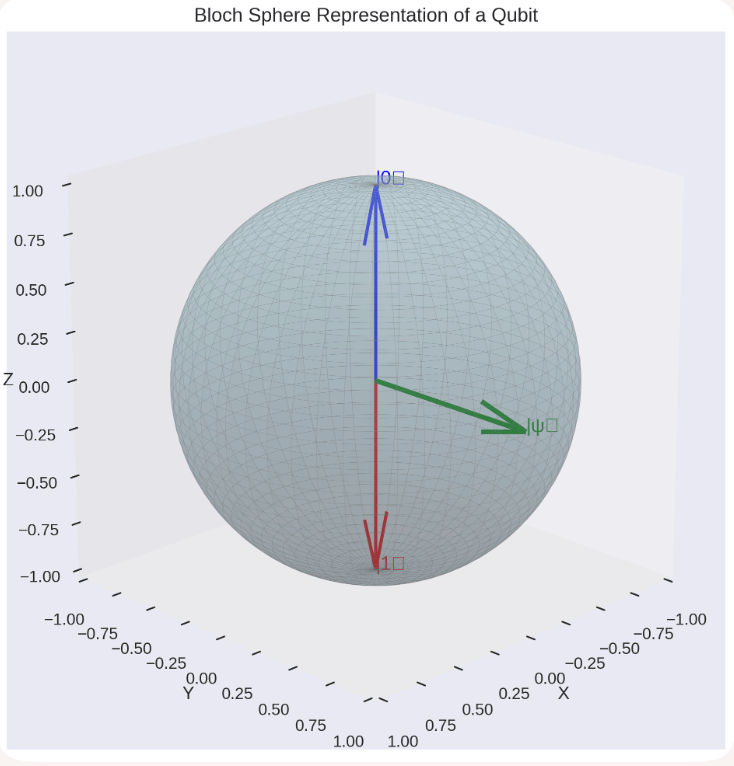
In the quantum world, you don’t have to be in the North Pole (say 1) or South Pole (say 2). You can be anywhere you want to be at the same time, even when you are sitting in a tiny flat in London. You just have to close your eyes and you get there.
So in a nutshell, Hilbert space is important in quantum computing because it’s the “stage” where all the quantum drama happens — the place where qubits live, interact, and perform their strange tricks. And this is the drama we prefer, rather than the energy-zapping “real-life” ones. But then we are two weird folks, a mathematician and a physicist.
 www.Fab4050.com