Probabilities, Primates and Purpose: My Path to Ethical AI
I don’t do things the conventional way. Probably because I am neurodiverse, and I learn by doing, and testing, and putting it out there to be challenged (detractors call it my vanity projects, but heyho, my money, my time, my life and therefore my choices).
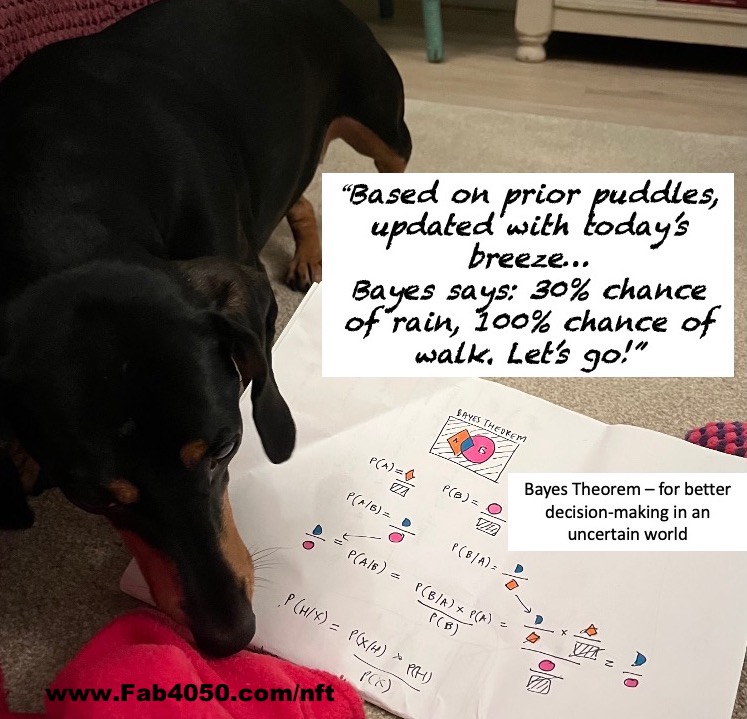
When I started thinking that Fab4050 needs a Large Language Model (LLM), I didn’t start with the latest transformer architecture or the biggest dataset. I started with something quieter, older, and—some might say—stranger: Bayes’ Theorem. You can read about it here.
It wasn’t the obvious choice. I’m not a machine learning engineer or data scientist by training. I don’t have a lab full of GPUs or a team of PhDs. But I do have something else: a mathematical lens, a deep respect for uncertainty and a lived understanding of what it means to navigate complexity without a map. And OK, I did learn some maths and computer science at Oxford a very long time ago.
Bayes’ Theorem is, at its core, a way of updating what we believe when new evidence arrives. “Truth” and decisions are not static in this quantum world, and Thomas Bayes (c. 1701 – 7 April 1761) was way ahead of his time with his Theorem. For Bayes Theorem doesn’t assume certainty. It doesn’t rush to conclusions. It listens. It adjusts. It learns. That felt like the right place to begin—especially for a platform like Fab4050, which is being built to support women going through menopause, many of whom have been misdiagnosed, dismissed, or simply unheard. So I thought this is a good place to start rather than wherever else those who are properly schooled would start.
We move from Bayes to Naive Bayes by applying Bayes’ Theorem to classification problems and making a simplifying assumption: that all input features are conditionally independent given the class label. This assumption—though rarely true in practice—makes the model computationally efficient and surprisingly effective:
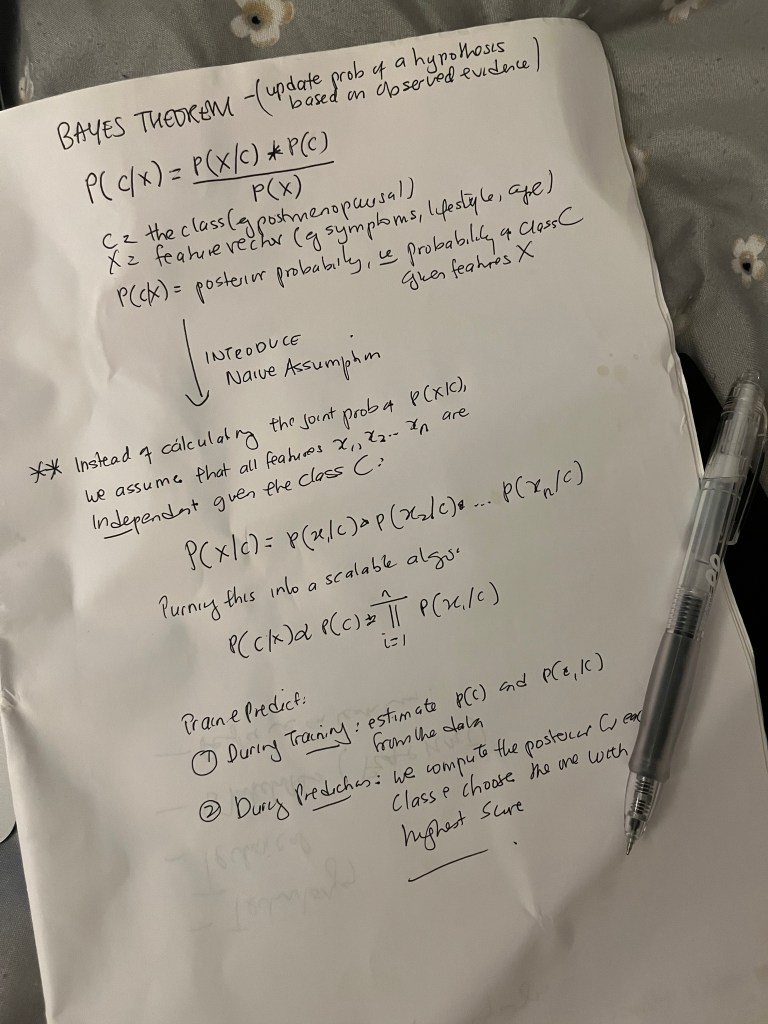
In this context, Naive Bayes can:
- Classify symptoms into menopause stages
- Predict user preferences for content
- Enable fast, interpretable decisions in low-resource (compute costs!) or privacy-sensitive environments.
In fact, this idea of probabilistic evolution—of traits shifting based on evidence—was something I first explored in a very different context: my Quantum Primate NFTs. Each primate was designed to evolve based on creator input, environmental triggers or community engagement (Paris Fashion Week). The logic behind that evolution? A simplified version of Bayes (above). If a user did X and Y, the probability of trait Z increased. It was playful, yes—but also deeply intentional. A meditation on identity, change and agency.
Now, that same logic into Fab4050’s LLM. I think we will call ‘her’ Mary, after my late mother Marion.
We’re building a hybrid model: a Bayesian core that handles fast, interpretable classification (like symptom triage or content recommendations), wrapped in a transformer shell that brings nuance, empathy and language fluency.
But this isn’t just about architecture. It’s about values.
Bayes gives us a way to model uncertainty with integrity. It lets us say, “We’re not sure yet—but here’s what we think, and here’s why.” That’s powerful in a world where women’s health is often reduced to binaries: normal or not, hormonal or hysterical, compliant or difficult. Fab4050’s LLM won’t flatten those complexities. It will hold space for them.
It also gives us a way to challenge bias transparently. Because Bayes makes its assumptions visible—its priors explicit—we can interrogate them. We can ask: whose data shaped this model? Whose voice is missing? And how do we update our beliefs as new stories come in?
This is especially important for women of colour, who are often underrepresented in clinical datasets and overrepresented in misdiagnosis statistics. With Bayes, we can start from a place of humility—and build a model that learns with, not just about, the women it serves.
One of Fab4050’s earliest backers once said of me: “She’s not afraid to get her hands dirty. She’s tireless. She’s fearless.” I carry that with me. It’s why I’m not afraid to start small, to start strange, to start with Bayes.
Because sometimes, the most powerful intelligence isn’t the one that knows everything—it’s the one that knows how to listen, how to adapt and how to grow.
And that’s exactly what Fab4050 is here to do.
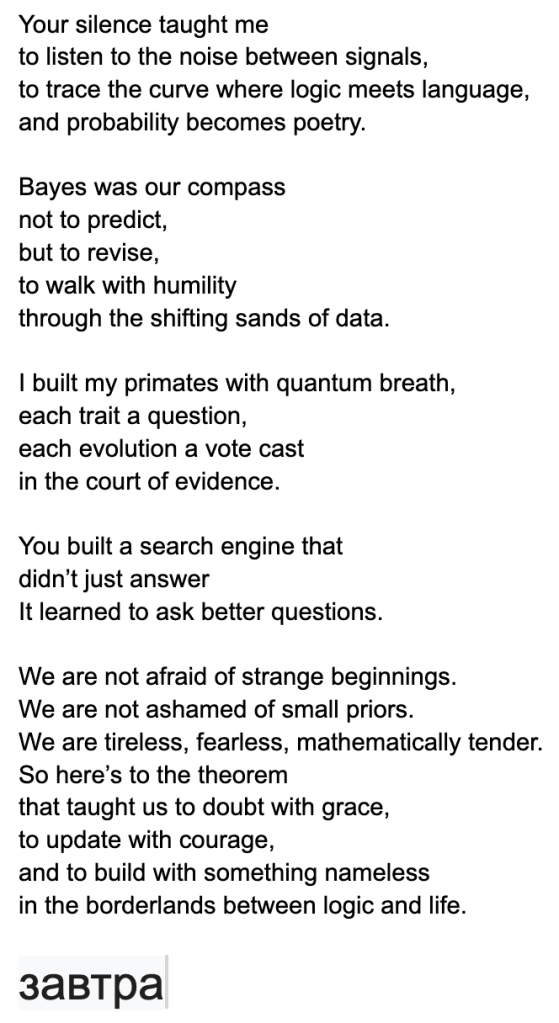
A poem from me:
 www.Fab4050.com