Minting Meaning: A Mathematician’s Path to Digital Expression
Nature isn’t 100% random—but it’s not 100% predictable either. It’s a fascinating mix of patterns, probabilities and chaos, a dance between order and chance—and that’s what makes it so beautiful and complex. This delicate balance between chaos and control is precisely what inspires modern artificial intelligence (AI). In AI systems, especially generative models, randomness is not just tolerated—it’s essential. It allows algorithms to explore creative possibilities, while constraints and rules guide them toward meaningful outcomes. This is evident in everything from generative art to synthetic data modeling. The goal isn’t to eliminate randomness, but to shape it—just as nature does.
The Quantum Primates NFT project embodies this philosophy. By using copulas to model trait dependencies, I’ve created a system where each NFT feels intentional, not arbitrary. Traits like “Golden Fur” or “Laser Eyes” emerge rarely, but they do so through a mathematically grounded process that respects both rarity and relationship. The result is a collection that feels alive—each Primate a digital organism with its own identity, shaped by both chance and design.
I invested much of my own time – all my waking hours in the past weeks – and my own money into bringing Quantum Primates to life. To the critics and detractors, citing the lack of guaranteed financial return and branding it a vanity project, this is what I have to say: life is never just about profit. It is about something far more profound, about the songs in our soul. In the case of Quantum Primates, it is about giving voice to my autistic identity and kaleidoscopic mind through a medium that speaks in code, structure and emotion. (Luckily, I am not dependent on anyone to fund my passion, and my days and nights are my own).
The algorithm that built Quantum Apes: Copulas
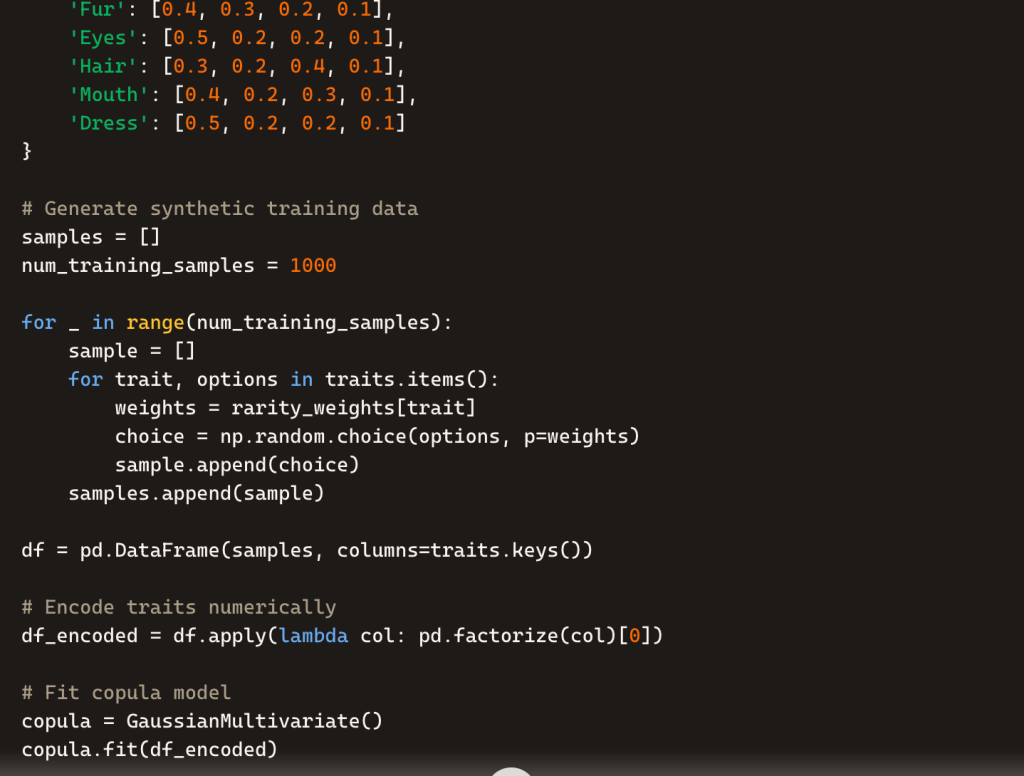
I first learned about copulas in the context of financial mathematics, where they are used for modelling joint asset returns and risk dependencies. For Quantum Primates NFTs, I used copulas to model how traits depend on each other, even if they follow different distributions. Instead of generating each trait independently, I used a copula to link their probabilities.
- Randomly generate NFT traits (e.g. fur colour, eyes, mouth, hair, dress)
- Ensure some traits are rare (e.g. crown – there is only one)
- Control how traits interact (e.g. certain eyes might pair with specific mouth, dress, etc)
- Avoid purely random combinations that feel chaotic or meaningless
Step-by-Step:
1. Define Trait Distributions
Each trait (e.g. fur, eyes, mouth, hair and dress) has its own probability distribution. The dresses are inspired by Paris Fashion Week and my own wardrobe.
- Mouth: 50% glam, 30% cheeky, 10% sexy, 10% JK
- Dress: 50% Paris Fashion Week, 30% JK wardrobe, 20% funky
2. Model Dependencies
Use a copula (e.g. Gaussian or Clayton) to define how traits relate:
- Glam mouths might be more likely with Paris Fashion Week
- Cheeky mouths might appear more often with JK wardrobe
3. Sample from the Copula
Instead of sampling each trait independently, I did this:
- Sample a vector of uniform random values from the copula
- Transform those values into trait selections using inverse CDFs (quantile functions)
This keeps the randomness but respects the relationships I’ve defined.
4. Inject Controlled Rarity
I assigned rarity weights to certain combinations:
- Only 1% of NFTs might have both XX and YY (you can work this out on the OpenSea page – call it investor research lol)
- These combinations are generated less often but still emerge naturally
5. Generate and Mint
Once traits are sampled and assembled, I did this:
- Render the image
- Attach metadata
- Mint the NFT with its unique trait signature
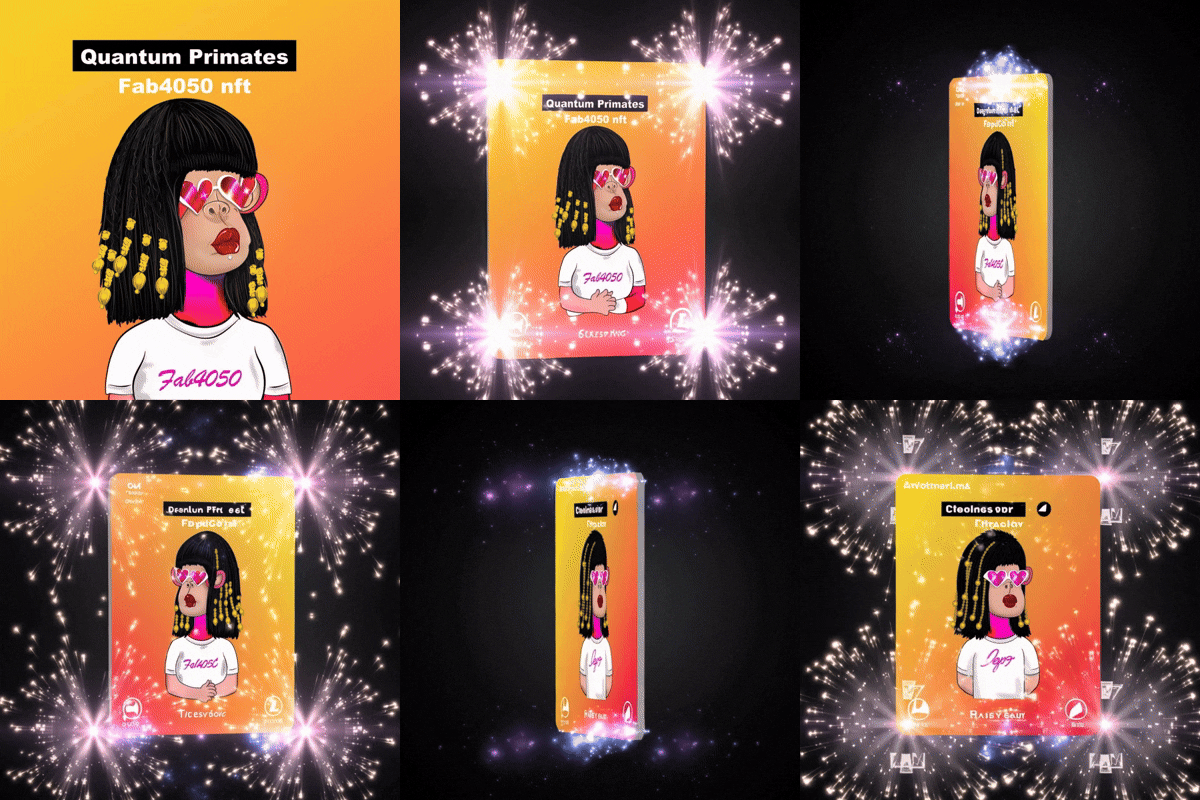
Photo: The Quantum Primate named “Dalisay” who is owned by one of the first supporters of Quantum Primates NFT – Genesis Edition.
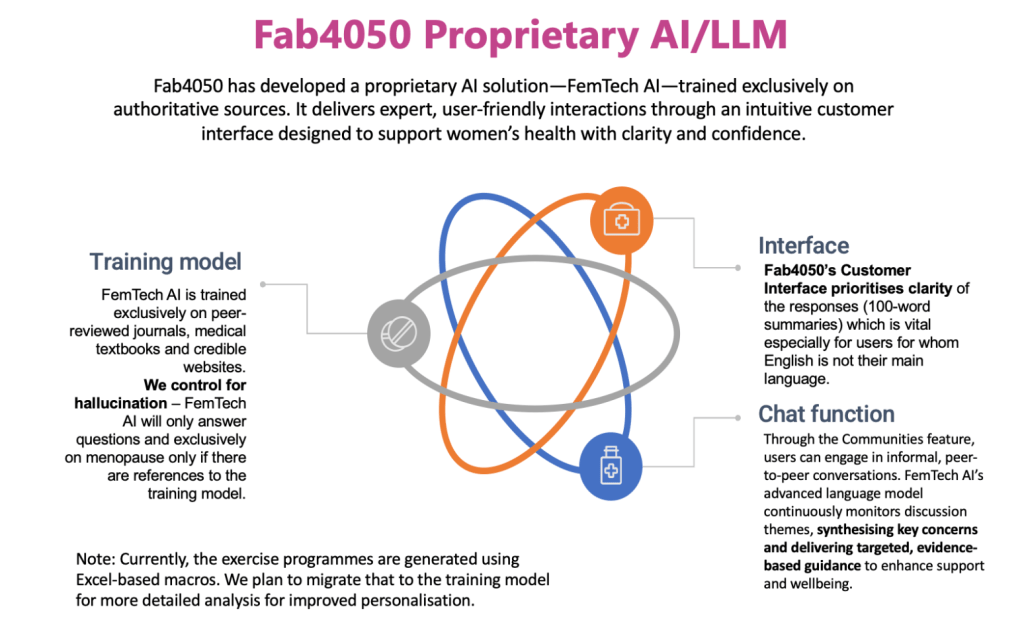
But no, this expensive journey is not for the sake of self-aggradisement. It actually gave me the time and space to explore how combining copulas with classifiers to improve how we estimate relationships, and how classifiers can help identify dependent vs. independent samples. What I have learned is that this hybrid approach leads to better feature engineering, more accurate predictions and robust simulations. I will use this to build LLM models to enable minority ethnic women for whom English is not their first language to access medical information related to menopause, which is a key component of the Fab4050 programme.
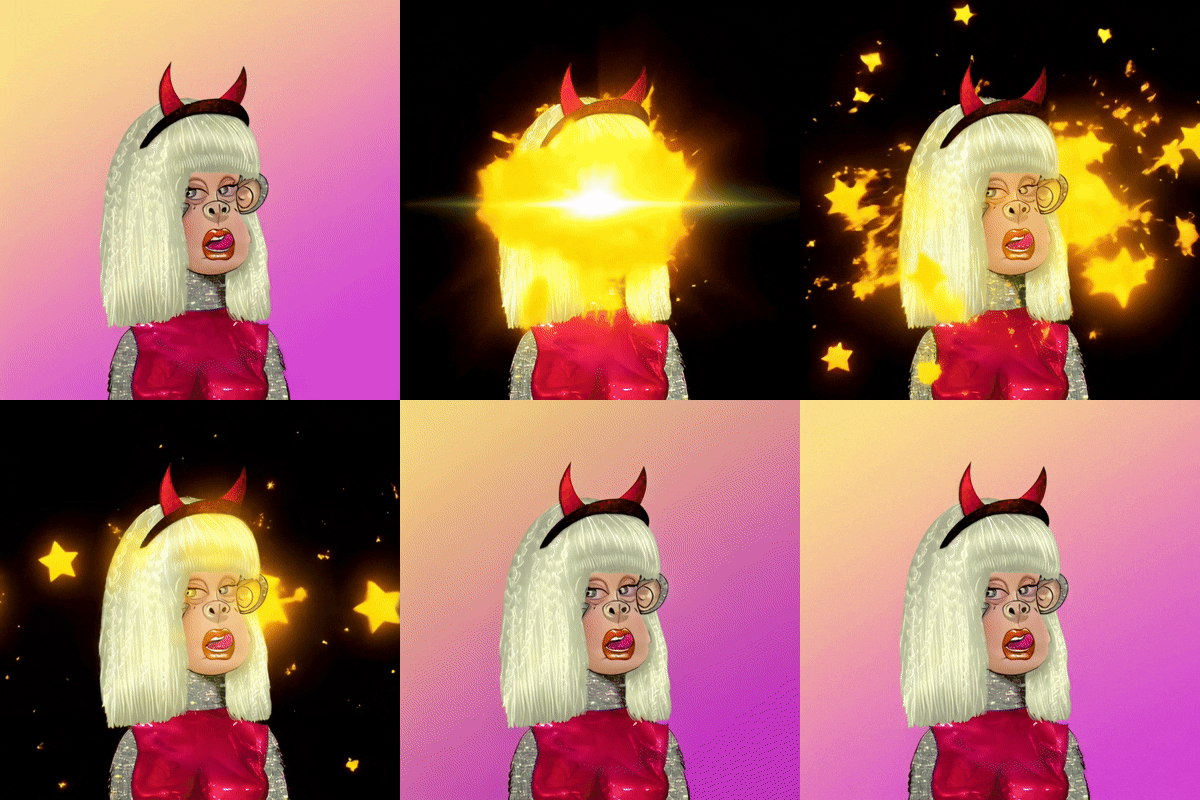
In this post, I shared the details of that journey—not as self-aggradisement but as an invitation to engage with the ideas in good faith. I hope that by opening up this experience, you may find inspiration or clarity in your own explorations. And hopefully, inspire you to own a Quantum Primate NFT. Pop over to OpenSea to see their traits. Those that are for sale will be listed on 17 October. https://opensea.io/collection/quantum-primates-genesis-edition
Photo: Me and the Quantum Primate named “Nouriya” (available for sale on 17 October) – my handle was “No Angel” 🙂

 www.Fab4050.com